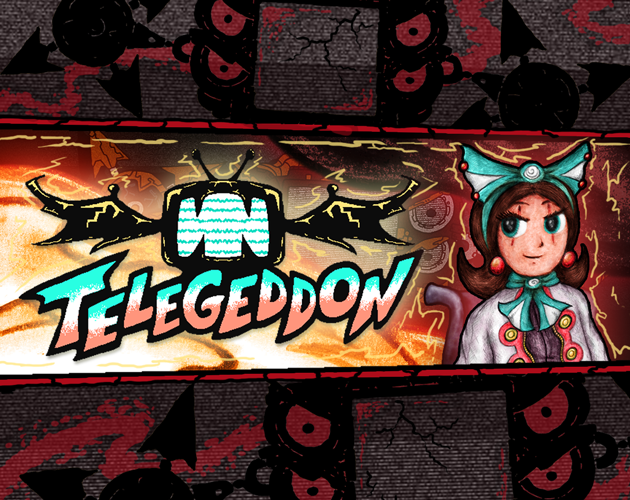
Much like Psycutlery, I would call this Telegeddon demo very indulgent in everything it does. The solo dev is not held back at all in terms of creative vision, which leads to a wide variety of very intricate and grimsical (grim whimsical) artwork on display. I particularly like the main character Hellen's animations, riding around on her souped-up wheelchair that bounces with a spring when you jump. Any platforming game that makes me bunnyhop solely because it's satisfying is doing something right! This same visual quality is true of their previous title, but I feel it works better here: Psycutlery was mainly very detailed pixel art, but a lot of higher resolution drawings intersect in a rather clashing manner. Telegeddon is able to keep barriers between artstyles by designing the minigames around them, while restraining the main platforming to that detailed spritework in order to keep a better immersion. The composer for Psycutlery also returns, but I would say there was a lot less music here, often focusing on absurd ambience during the minigames that reflects the weirdness you're seeing. Maybe that comes from it being a demo.
I call them minigames because I would say they're closer to those than microgames, since most of them last more than five seconds. I was a little worried at first that they were getting repetitive and would continue to; after all, they're the method of battling enemies so repetitive minigames equates to leveling up feeling like a grind. As I played though there was thankfully a wider variety than I expected, and even when some are reused, they're given fresh coats of paint to match the settings you're in better. What helps is that the microgames don't feel totally disconnected from the enemies based on how they behave: while the regular mooks usually take 2-3 games' worth of damage to defeat, some smaller foes take only one. Some enemies also initiate minigames that you must clear, or else you'll take a larger chunk of damage. There's also minibosses and bigger bosses that have a selection of unique games based off of them and the scenario the player is in. I can see future enemies shaking up the way you play the minigames in other different ways, and all in all I would say getting put on the spot to play some minigames never grew grating.
The minigames being so action-packed means the more explorative platforming is a nice compliment. I think what helps them not clash too much is the fact that a lot of minigames already feature characters that you move and make jump, so the 2D platforming keeps me warmed up when it's time to play them. Often the platforming mechanics will weave into the minigames: one area had me knocking bombs into rocks to clear them, then the boss of that area also has minigames with those bombs. It feels neat to be introduced to a gimmick in one mode of play and then find it into the other. There's also an upgrade to unlock in this demo for Hellen's wheelchair that gives her flight, though it is implemented in a rather odd fashion: rather than letting you toggle the ability, you can only activate it at stations sprinkled in the levels, with barriers appearing over rooms that the game deems too far ahead. I suspect this is to keep sequence breaking off the table, though there was probably a more elegant way of implementing this, such as putting the ability on a timer so you can only fly so far at once.
My biggest concern with the game is that the overall pacing is a little off, an issue I also had with Psycutlery. Initially, I felt fights were much more of a drag because before each minigame, a movie clapper displaying instructions introduces the game for a few seconds. I get the reason for wanting to do this, making sure the player knows what to do is important, but it displays for a little too long to feel like an interruption. You can thankfully turn it off in the options menu, and even after I did that I was still able to pick up and play most of the games, since the objects you control are usually marked by Hellen's bow. The only exceptions where I started off confused were the games where you control two characters at once, since they aren't nearly as frequent. This is why I think regardless of what option I toggle, I think the clappers should be quicker than a few seconds, or maybe just implement a sound effect when a game has you control two things.
Like the artwork, the story is also very indulgent, and it starts off a bit slow. There's a lot of text in a rather clashing albeit readable font, most of it optional but the occasional cutscene will go on for a while. It also, again like Psycutlery, tries to set up a lot of lore through dialogue; some of it is humorous, but a lot feels rather unnecessary, like it has to justify the quirks on display rather than showing me without telling, or at least wording it in a way that feels less like exposition. The gamers who just wanna game may be dragged down by all the words, but I didn't mind it too much, being a human typewriter and all. I think the characters and story that are being set up are interesting, and while the villain takes a while to appear, they leave a good first impression that makes me wanna keep playing. I don't think I'll be excited to experience all this text again on a potential replay however, once I already know it. You can skip dialogue boxes, but not the cutscenes themselves, so I can already picture myself spamming a key just to get past a dozen paragraphs. Psycutlery had an option to disable cutscenes after first watching them, so maybe that feature can return for convenience.
Overall, I had a fun time experiencing this new endeavor from EiE! Very excited to see where it goes.



 eyesineverything.itch.io